The Islands
The islands
115 islands, two geologies, a life of their own. Here is how we read the archipelago.
Two geologies
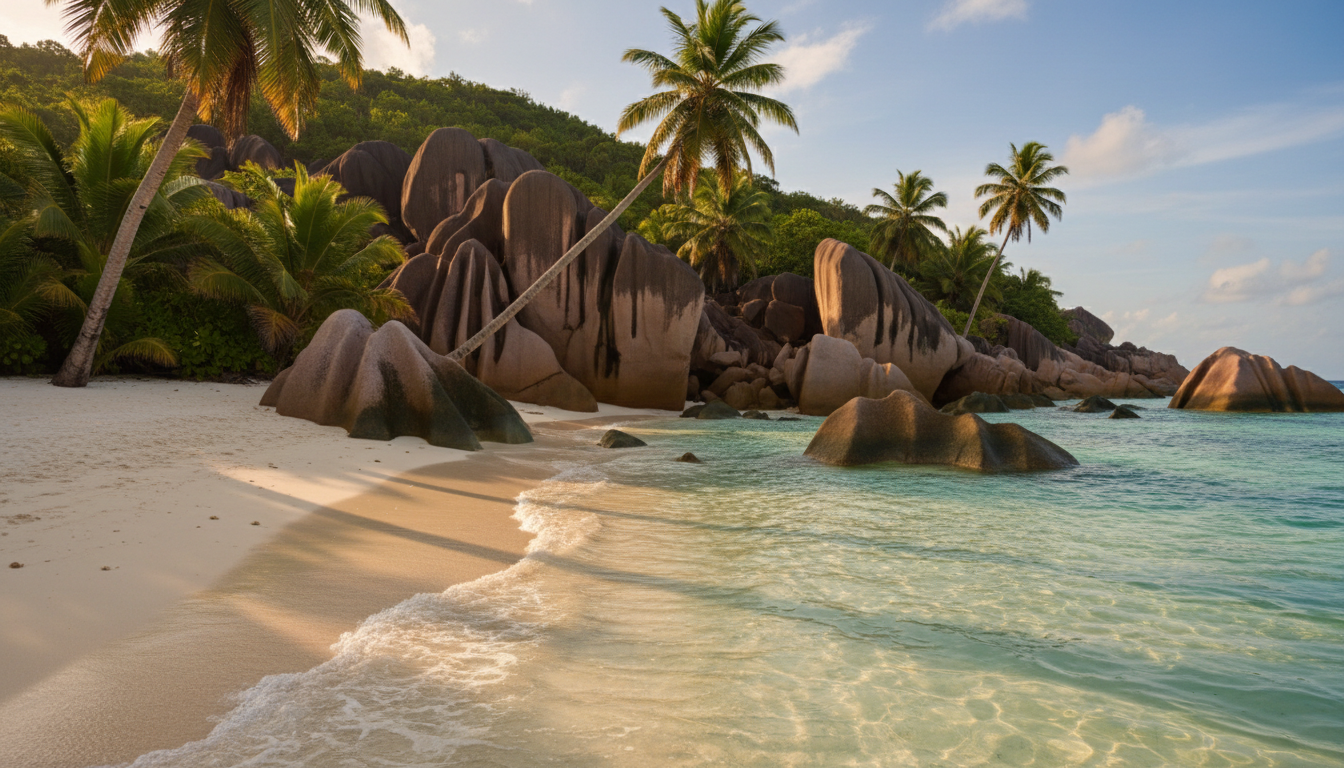
The Seychelles is unlike any other ocean. Most island groups in the Indian Ocean and Pacific are volcanic — born from the sea floor, young in geological terms, and uniform in character. The Seychelles inner islands are none of these things. They sit on a fragment of ancient continental crust, separated from what is now India roughly 75 million years ago. The granite that erupts from the sea at Anse Source d'Argent on La Digue, or from the boulders at Beau Vallon on Mahé, is the same rock that once lay at the heart of Gondwana. It has been here far longer than we have.
The outer islands are different in every way. Flat, coralline, and recent — built from the accumulated skeletons of reef organisms over tens of thousands of years. Aldabra, the largest raised coral atoll in the world, sits 1,100 kilometres from Mahé. It has no permanent human population, no tourist infrastructure, and 150,000 giant tortoises that have never learned to be afraid of anything, because nothing has ever threatened them here. It is one of the last ecosystems on earth that is functioning as it did before human contact.
We know both geologies intimately. Our guides have walked the granite paths and the coralline flats, dived the inner reefs and the outer atolls. The islands below are a starting point. The conversation will tell us which ones are right for you.
Archipelago Map
Navigate the islands
Hover over an island to learn more, or click to visit its page.
Island groups
Inner Islands
Granitic, ancient, and close together — Mahé, Praslin, La Digue, and their satellites. Where most journeys begin.
Private Islands
Whole-island resorts where the staff outnumber the guests and the beaches have no footprints.
The Outer Islands
Remote, wild, expedition-grade. The Amirantes, Alphonse, and — if you are ready — Aldabra.
Conservation and access
Several of the islands we work with are protected under national or international conservation frameworks. Aldabra is a UNESCO World Heritage Site, managed by the Seychelles Islands Foundation, and access requires a permit that the SIF issues at its discretion. Cousin Island, managed by Nature Seychelles, receives guided visitors only. Curieuse is a national park.
These restrictions are not obstacles. They are the reason the islands look the way they do. We coordinate all permits, conservation fees, and access arrangements as part of your journey — and we explain, to every guest, what the fees fund and why the frameworks exist. A visit to a protected island is a contribution to its continuation. We think guests should know that.
Archipelago Calendar
When to go
Jan–Mar
Northwest monsoon. Calmest seas, warmest water. Best for sailing and snorkelling.
Apr
Transition month. Visibility improves to 30 m. Whale sharks begin arriving.
May–Sep
Southeast trades. Drier, cooler. Best for fly-fishing and hiking.
Oct–Nov
Turtle nesting season on the outer islands. Mango season on Mahé.
Dec
Festive season. Book 12 months ahead for private islands.
Keep exploring
More of the Seychelles
The journeys
Honeymoons, family weeks, and expeditions
Curated programmes
Starting points, each fully adjustable
The field guide
The archipelago, written by locals
When to travel
How we read the calendar
The yacht desk
Shore support for your passage
The journal
Field notes from our island team
Begin a conversation
Five fields, a reply within 12 hours
Begin a conversation about the islands.
Begin a conversation