The Islands
Mahé
The feel of it
Mahé is 27 kilometres long and rises to 905 metres at its highest point — a mountain that pulls cloud off the Indian Ocean and drapes it across the peaks, keeping the interior cool and the rivers running year-round. The Morne Seychellois National Park covers more than a third of the island, and within it are 20 kilometres of marked trails through cloud forest that smell of cinnamon and wet earth. On a clear morning at the summit of Morne Blanc, you can see Praslin and the satellite islands arranged on the water like a scatter of dark shapes. Most guests who arrive in the Seychelles never see this view. They go to the beach. We understand, but we always suggest one morning in the forest first.
Victoria is the world's smallest capital — a town of 25,000 people, a clock tower that is a quarter-scale replica of London's Big Ben, and a market that on Saturday mornings smells of turmeric and bilimbi and salted fish. The Sir Selwyn Clarke Market on Albert Street is where the island buys its fruit, its spices, and its conversation. It is the best hour you will spend without a beach view in the Seychelles.
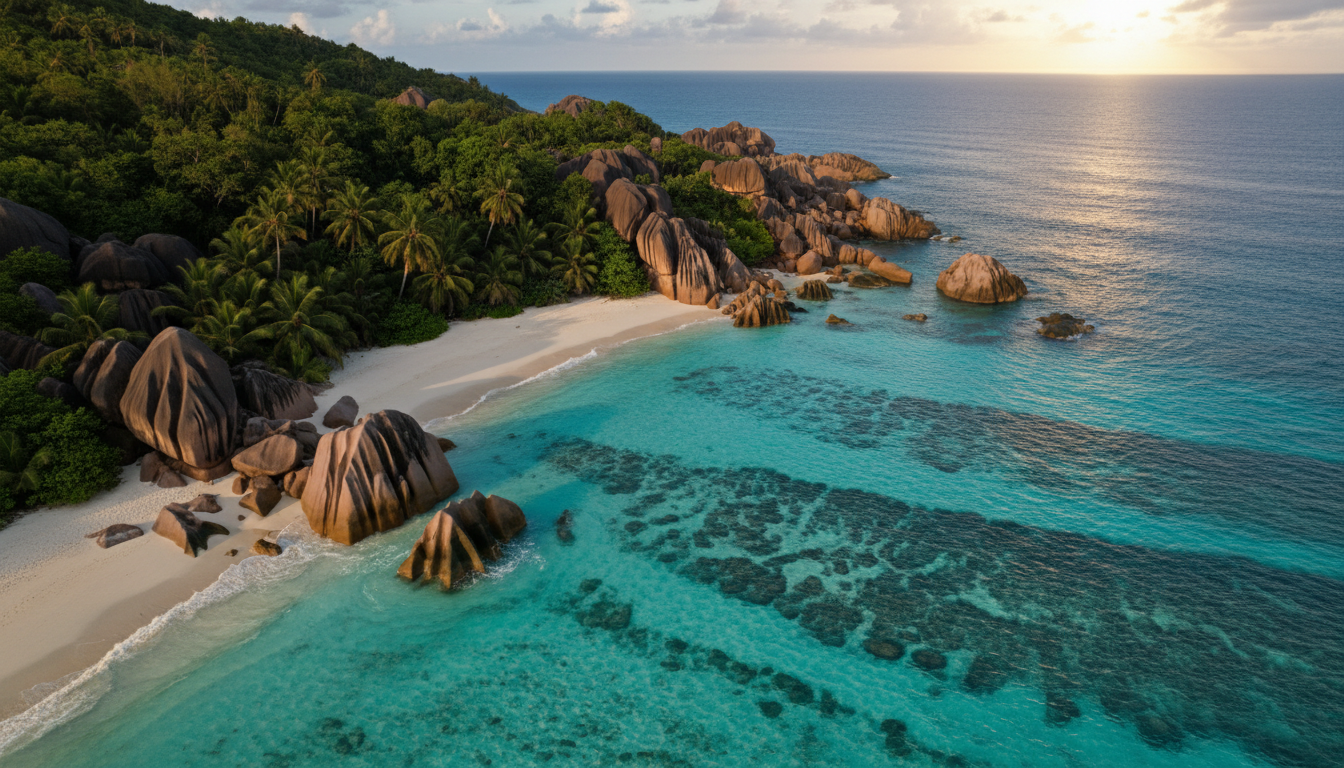
The south coast of Mahé — from Anse Royale down through Anse aux Poules Bleues to Anse Intendance — is among the most beautiful coastline in the Indian Ocean. Anse Intendance, facing the open sea, has a swell in the southeast trade season that makes it the only surfable beach in the archipelago. Anse Royale, sheltered and shallow, is where Marie-Claire runs the kitchen that has been producing the best octopus curry in the Seychelles for nineteen years.
Shark Bank, twelve kilometres west of Mahé, is a seamount that rises from 35 metres below the surface. It is home to grey reef sharks, eagle rays, and in April — during the seasonal transition — whale sharks that follow the tuna north from the equator. We put our dive guests in the water here before they see any other reef. It establishes a standard that everything else in the archipelago must then meet.


Size
157 km²
Geology
Granitic — highest point 905m
Best season
Year-round; April–May for hiking
Gateway
International airport (SEZ)
In depth
Understanding Mahé
History
Mahé was uninhabited when the first French expedition, led by Lazare Picault, landed in 1742. Picault named the island after Bertrand-François Mahé de La Bourdonnais, the French governor of Mauritius. The first permanent settlers arrived in 1770 — a party of 15 French colonists and 7 enslaved Africans who established the foundations of what would become Victoria. The island passed to Britain under the Treaty of Paris in 1814, and remained a British crown colony until independence on 29 June 1976. In 1977, a coup led by France-Albert René overthrew the first president, James Mancham, and established a one-party socialist state that endured until multiparty elections were restored in 1993. Mahé was the centre of all of this — its port, its airport, and its government buildings the physical backdrop of the republic's turbulent political formation.
What to do — by appetite
Sea
- Shark Bank diving — 50+ grey reef sharks
- Beau Vallon snorkelling
- Fishing with local pirogue captains
Land
- Morne Seychellois National Park trails
- Saturday market in Victoria
- Tea plantation visit in the hills
Culture
- Natural History Museum — coco-de-mer and tortoise exhibits
- Creole dinner at a family-run Anse Royale restaurant
- Early morning market at the Sir Selwyn Clarke Market
Endemic species & notable ecology
- Seychelles kestrel
- Seychelles sunbird
- Hawksbill turtle
- Giant Aldabra tortoise (Botanical Gardens)
Begin a conversation about Mahé.
Begin a conversation