A morning with the Vallée de Mai wardens
By Annette Rosalie
Conservation Liaison, Seychelles Travel Co.
The Vallée de Mai opens at 8am. The wardens arrive at 6.
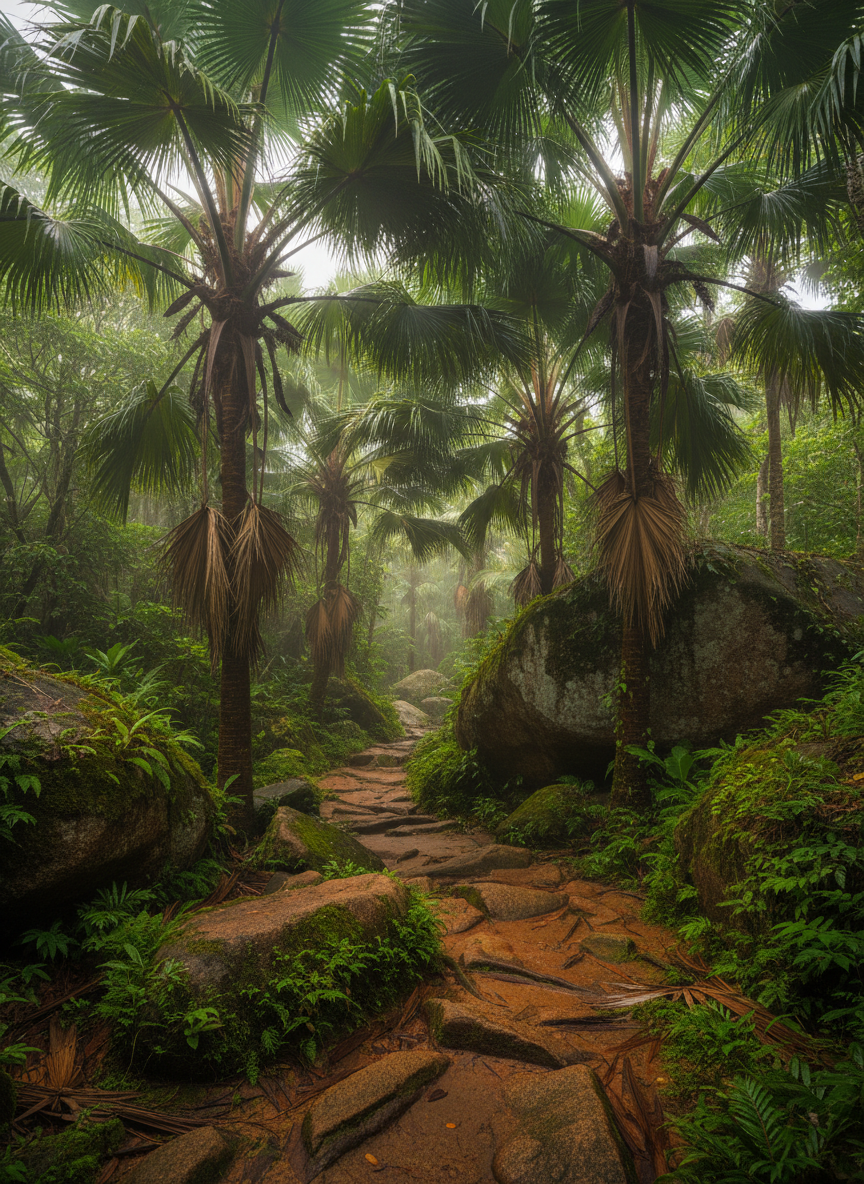
I joined Daniel — a SIF warden who has been monitoring the valley since 2011 — on his morning circuit. The circuit takes about ninety minutes if you walk it without stopping. Daniel has never walked it without stopping. There is always something.
This morning it was a black parrot, the Seychelles' only endemic parrot species and one of the rarest birds in the Indian Ocean, feeding in a coco-de-mer canopy. Daniel noted the tree number in his logbook — every coco-de-mer palm in the valley is individually numbered and monitored — and counted the feeding time. Eleven minutes. He has been recording feeding times for four years. He is building a dataset on diet seasonality. He does not have a university position. He has a logbook and a forest he knows better than his own house.
The coco-de-mer palm produces the world's largest seed: a double coconut that can weigh up to 25 kilograms and takes seven years to mature. The Seychelles Islands Foundation controls every seed that leaves the island under a permit system so strict that attempting to export one without documentation is a criminal offence. This is not bureaucracy for its own sake. It is the only reason the species still exists in the wild.
There are approximately 4,000 coco-de-mer palms in the Vallée de Mai. It is the last primary forest of its kind anywhere on earth. It has been standing — as a forest, not as a ruin — since before humans arrived in the Seychelles in the eighteenth century.
By 9:30, the first tourists are arriving. Daniel finishes his circuit and takes up his position at the entrance, where he will answer questions about the palm's reproductive biology — it is memorably explicit, which is why visitors photograph the female palms — for the next six hours. He does not seem tired of the questions. He seems glad of them.
*Palmis* — the palm. But say it to a SIF warden and they will hear something closer to responsibility.
A note on language
«Palmis»— the coco-de-mer palm — but locals use it to mean something irreplaceable